Posts

Showing posts with the label holy spirit

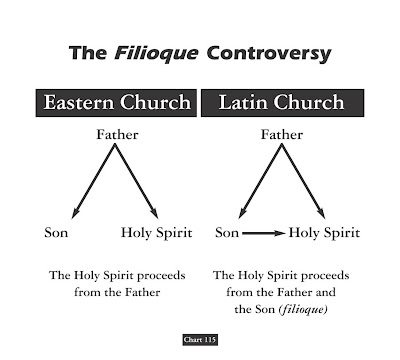
Debating The Filioque and Incarnation: A Comparative Analysis of Eastern Orthodox and Thomistic Perspectives on the Trinity
Image
Debating The Filioque and Incarnation: A Comparative Analysis of Eastern Orthodox and Thomistic Perspectives on the Trinity The Eastern Orthodox claim that the three persons in the Trinity have the same divine will and power since they are the One God. However, if one does not affirm that they have the possibility of becoming incarnate then this would entail that they do not have the same power as only the Son has the power to become incarnate, while the Father and Holy Spirit cannot. If there are three persons who are each divine and yet share different powers then there is a strong argument that this leads to three gods rather than one. The idea that the Son alone has the power to become incarnate comes from Book 4 Chapter 4 of An Exposition of the Orthodox Faith by John of Damascus, “The Father is Father and not Son: the Son is Son and not Father: the Holy Spirit is Spirit and not Father or Son. For the individuality is unchangeable. How, indeed, could individuality continue to exi...
Challenging the Trinity: Indexicals and the Leftow Dilemma

Image
Challenging the Trinity: Indexicals and the Leftow Dilemma     The Doctrine of the Trinity stands as a central tenet of Christian belief, positing the existence of three distinct persons—Father, Son, and Holy Spirit—within the divine unity of God. However, a nuanced examination reveals intriguing challenges that will be discussed in detail. This blog post will present two more arguments against the Doctrine of the Trinity. I have already discussed the Logical Problem of the Trinity (LPT) and how the Trinity contradicts Divine Simplicity elsewhere on my blog.   The Argument from Indexicals:   Indexical: A linguistic expression whose reference can change based on the context. Examples of indexicals include I, he, she, here, that, etc. If Person A says I am happy and Person B utters the same sentence, even though the sentence is the same, Person A is saying it while person B is saying it. In the orthodox conception of the doctrine of the Trinity, there is only one mind ...

Notes of the Overview of the Early Church Fathers: On the Trinity and Incarnation

Image
Notes of the Overview of the Early Church Fathers: On the Trinity and Incarnation      In our exploration of early Christian thought, our focus is directed towards understanding the evolving perspectives on the Trinity and the Incarnation as articulated by influential figures within the Church such as Clement of Rome, Ignatius of Antioch, Justin Martyr, Irenaeus of Lyon, Tertullian, Origen of Alexandria, Athanasius, and others, thus providing a comprehensive understanding of the theological landscape that shaped Christianity during its nascent stages. While I cannot go over all the early church fathers since that would take up the length of the book, investigating these influential individuals who are mostly saints will have to suffice. This will also ignore early modalist theologians (who believed that the Father, Son, and Holy Spirit were one person and modes of God), gnostic theologians (who believed in many gods and that Jesus was not a human), and Jewish-christian th...

Trinitarian Dynamics: Exploring Divine Processions and Relations in Thomistic Theology

Image
Trinitarian Dynamics: Exploring Divine Processions and Relations in Thomistic Theology     Under a Thomistic interpretation of Christianity, God the Father is the one who possesses the divine essence in an absolute sense such that he is unbegotten. Before all ages he has always been and will be an eternal act of communicating the divine essence out. Imagine having an idea about yourself, this idea is like you but it will not be exactly you due to human limitations of imagination and therefore, will not be a perfect image. However, God knows himself perfectly and he is the only thing that can possibly understand his own essence. In his act of understanding himself it will be a perfect image with the same essence as it will be identical as it will be a reflection of his essence. Therefore, the Son proceeds by way of knowing. Knowledge is a procession. The reason why it becomes a person is because it is the perfect image of the divine essence.       ...

Reviving Monotheism: Exploring Tensions within Monarchical Trinitarianism

Image
Reviving Monotheism: Exploring Tensions within Monarchical Trinitarianism     According to Monarchical Trinitarianism, the Father’s existence is fundamental while the Son and the Spirit have a derivative status as the Father grounds their existence yet they share the same essence such that they exemplify what it takes to predicate divinity (excluding aseity it seems). Therefore, when they refer to there being only one God they are referring to the one fundamental divine person who is the Father while there are three divine persons and therefore “monotheistic” as they are defining monotheism as the existence or worship of one fundamental divine person. Therefore, in one sense there are three Gods as there are three divine persons but in another sense there is one God as there is one fundamental divine person. However, the Monarchical Trinitarian is equivocating on the term, “God”. To be God one must have all the qualities that are necessary and sufficient to be God. If there ar...

The Doctrine of the Trinity in the Faith of the Early Church

Image
The Doctrine of the Trinity in the Faith of the Church      The doctrine of the Trinity is at the heart of the Christian conception of God. However, there can be misunderstanding of what this doctrine entails regarding the nature of the being of God and the three persons of the Trinity. According to the doctrine, God is one divine being who exists eternally in three distinct but co-eternal and co-equal persons: the Father, the Son (Jesus Christ), and the Holy Spirit. Each person is fully God, and yet there is only one God. The Father is not the Son or the Holy Spirit, the Son is not the Father or the Holy Spirit, and the Holy Spirit is not the Father or the Son. They are three distinct persons who share the same divine nature. While some have struggled to reconcile the concept of one God in three persons with the idea of monotheism, the doctrine of the Trinity is an essential aspect of orthodoxy by the majority of Christian denominations.       The nat...