Posts

Showing posts with the label advaita vedanta

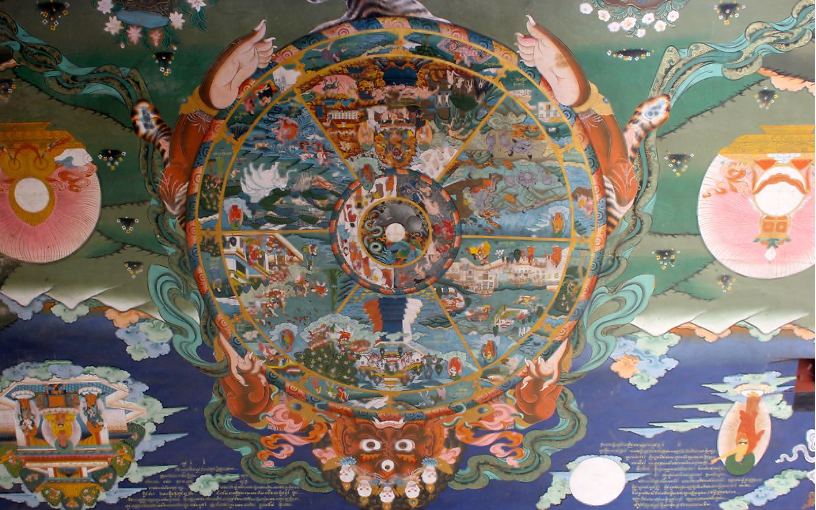
An Explanation of Reincarnation in Hinduism
Image
An Explanation of Reincarnation in Hinduism   “Just as the embodied soul continuously passes from childhood to youth to old age, similarly, at the time of death, the soul passes into another body. The wise are not deluded by this.” (Bhagavad Gita 2:13)            The soul that animates the body will survive while the body does not according to Hinduism. This next body will be destined by the actions in their previous life and this is the concept of karma. Good intent and actions lead to a good future while bad intent and actions lead to a bad future. But what is exactly the soul? Is it the Atman? The Atman is identified with the consciousness of the human being that is all-pervasive amongst all that exists. The Atman is eternal reality, indestructible, and bliss and is identified with Brahman or God who is the true reality of everything. However, since the Atman is everywhere and unchanging and is in all beings, it is not the one that ...

Kantian Idealism and the Quest for Ultimate Reality

Image
Kantian Idealism and the Quest for Ultimate Reality   I pondered over Kant and his philosophy of transcendental idealism and then contemplated Descartes and discovered they have significant overlap. Kant claimed we cannot know the world in itself i.e. the noumena but only have knowledge of the world as it appears to us i.e. the phenomena. Then I drew a parallel of this idea to Descartes’ radical doubt which claimed that we cannot know if the external world exists or not, but the one thing we have epistemological certainty of is Cogito Ergo Sum or I think therefore I am. The overlap being lack of true knowledge of the external world. Then I thought about how religion can be incorporated. It is explicit in Descartes that the external world is clear through his faith in God through his ontological argument but for Kant such a thing is absurd as he believes philosophizing about God is beyond the scope of what philosophy can accomplish and therefore he rejects cosmological and ontologi...

Exploring Monism in Kantian Philosophy and Schopenhauer’s Will Through Advaita Vedanta

Image
Exploring Monism in Kantian Philosophy and Schopenhauer’s Will Through Advaita Vedanta     This blog post explores monism within Kantian philosophy and Schopenhauer’s concept of the “Will” through drawing parallels with Advaita Vedanta, a school of thought in Hinduism, as the title suggests. In Kant's philosophy, the noumena, or the “thing-in-itself” represents the ultimate reality of objects independent of our perceptions. Kant argued that we can never have direct knowledge of the noumenal realm because our knowledge is necessarily mediated by the structure of our minds and senses. This is explored much more in-depth in my other blog posts on the basics of Kant. While we can perceive and understand phenomena—how things appear to us—the nature of the noumena remains inaccessible. Kant posited that our experiences are shaped by the 12 categories of the understanding and the forms of intuition, and these mental structures impose limitations on what we can know about the underl...